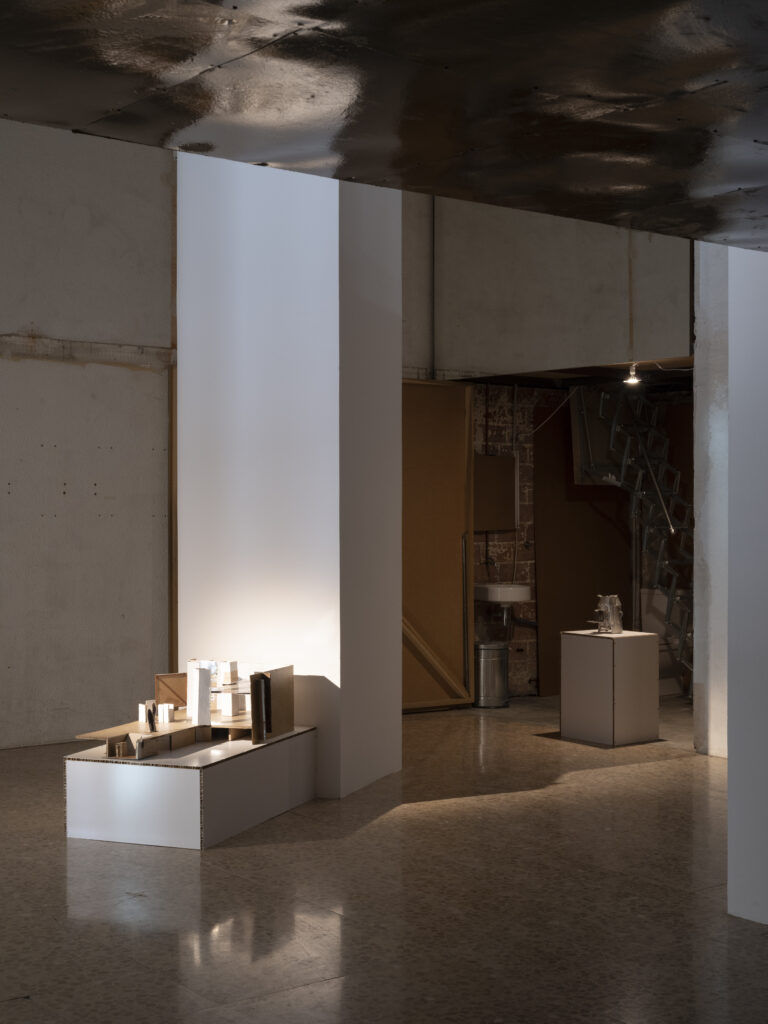
Exhibition by Laura Sebastianes at Dilalica. From 25 June to 31 July 2026.
We hope that a change will take place, or perhaps, more precisely, an exchange — one thing for another, a two-way process in which two or more parties give something to one another, involving a certain reciprocity.
Laura Sebastianes proposes a variation on the title of Antonio Tabucchi’s short story Change of Hand, which inspired the title of this exhibition: the addition of exclamation marks to an apparently neutral phrase. A shift clearly takes place here, moving from a simple gesture to a field of possibilities: a call for attention, an announcement, a warning sign, a sudden action. At the same time, this movement of passing something from one hand to another acquires a certain lightness and irony.
The transformation of Dilalica proposed by Laura Sebastianes consists primarily of a series of partial exchanges between scales, functions, and modes of occupying and expanding the exhibition space itself. The works transfer properties from one realm to another: the model takes on an architectural presence, architecture behaves like sculpture, the interior absorbs the exterior, and the exhibition space ceases to function as a container and instead becomes an interlocutor. The use of areas that are not normally intended for exhibition purposes, such as the storage room and the bathroom, together with the incorporation of new spaces — such as the mezzanine, which already existed before Dilalica opened as an exhibition space — extends this logic of displacement and transfer. The exhibition thus continually renegotiates its own limits and modes of use. Through these gestures, Laura makes visible an architecture that seemed to remain in reserve, as though the exhibition had shifted, in a change of hands, the weight of one place onto another, revealing spaces that had always been there but had not yet been activated.
In Tabucchi’s story, the information surrounding the exchange that is to take place for unknown reasons is never made explicit. As the story unfolds, the seemingly simple act of handing something over to someone else gradually shifts into a more ambiguous territory in which memories, identities, and roles begin to exchange places. Theatre then emerges as a central setting: the characters appear to perform within a play whose script they do not know, watching one another as spectators of a scene. The change of hands ultimately reveals itself as a broader operation of substitution and displacement, in which different layers — reality and fiction, past and present, even life and death — constantly mirror one another.
The exchange that never fully becomes explicit in Tabucchi’s story introduces into Laura’s proposal a relational dimension that resonates with the practice of the architect Raimund Abraham, for whom architecture could exist as an idea, a model, or an intervention, without any obligation to resolve itself into a building. His drawings, models, and constructions were states that exchanged functions and statuses among themselves. In this sense, the model, rather than merely preceding the building or the space, as it does in this exhibition, can possess the same autonomy as either of them.
Just as, in Tabucchi’s story, the characters act within a theatrical performance whose meaning remains partially concealed, Laura’s intervention transforms Dilalica into a kind of scenic apparatus in which each space seems temporarily to assume another function. She proposes a series of interventions in which architecture and fiction become intertwined in spaces that appear to exist simultaneously as real places and as stages. These displacements — a folding staircase that grants access to a space usually inaccessible to the public, a storage room that opens up, a reclaimed mezzanine — operate as changes of hands: small movements that alter the relationships between things and make the space strangely unfamiliar to itself within this dramaturgy of exchanges.
Like the exclamation marks added to the title, sometimes the smallest gesture is enough for something familiar to cease being exactly the same and reveal itself in a different light. It is then that the change we may have been waiting for finally takes place.
Text by Sergi Álvarez Riosalido