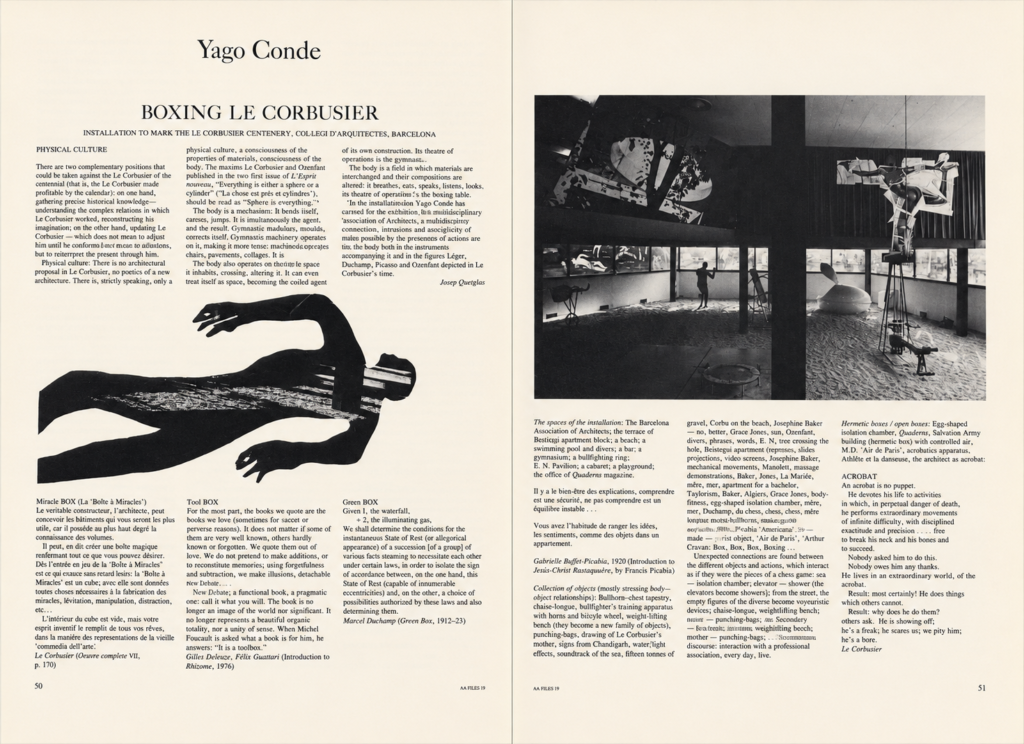
“A body is a physical mechanism. It bends, tenses, jumps. A body is simultaneously the agent and the result of action. The body is constructed, shaped, corrected.” This is how Josep Quetglas opens his text on Boxing Le Corbusier, the installation Yago Conde produced at the COAC to mark the architect’s centenary. Here, the body, beyond being an abstract measure of architecture, becomes matter that bends, tenses, jumps, and moves through objects and spaces at the same time as they move through it. A chair alters a back; a pavement eventually imposes a way of walking. The body acts upon its surroundings, but is also produced by them.
The final verb in Quetglas’s list, to correct, allows us to pose a further question: correction according to what model, with what idea of a correct body in mind? An entire apparatus of knowledge, objects, and architectures is required to determine its proper position, its possible movements, or its limits. The physical culture that Quetglas identifies in Le Corbusier – this simultaneous attention to the properties of materials and those of the body – implicitly carries a politics: wherever a body can be shaped, there already exists the possibility of deciding what form it should take.
It hardly seems coincidental that Yago Conde himself took an interest in this question in his doctoral thesis. In one chapter of his research, he describes the body in confrontation “with the systems that culture and power have imposed upon it” (1), and proposes, in response to them, the possibility of the “subversion, manipulation and destabilisation” (2) of the constants that seek to order it. Moreover, in analysing the work of Diller, Scofidio and their relationship with Duchamp, Yago Conde identifies a world of scales, measuring instruments, prostheses, and architectural devices before which “the body is continually questioned, confronted, dressed, concealed, placed within coordinates, revealed, in tension with these devices of measurement and observation” (3). The body thus appears as something that becomes legible through contact with a series of devices, rather than as a prior and autonomous entity upon which architecture subsequently acts. Measuring a body, observing it, illuminating it, or placing it within a set of coordinates are also ways of producing it.
Boxing Le Corbusier was presented in Barcelona in the late 1980s, a moment hard to read as neutral. It was in 1992 that the city presented itself to the world through the grand corporeal spectacle of the Olympic Games: trained, measured, disciplined bodies, displayed as images of performance and health. It was also a moment marked by another way of making the body visible. A decade after the first HIV/AIDS diagnoses, the Western body had acquired a new political condition: it could be a carrier, it could be contaminated, it could belong to the “general population” or be inscribed within a so-called “risk group.” The disease turned certain sexual practices into signs through which entire bodies and communities could be classified. Susan Sontag had already pointed this out in AIDS and Its Metaphors (1989): the epidemic reactivated an old moral operation, that of turning illness into the index of a transgression (4).
There is no need to assume that Yago Conde explicitly theorised this relationship between the Olympic body and the epidemiological body, but the contemporaneity of the two, together with his direct experience, is, at the very least, gives pause: while some bodies were being trained to represent the vitality of a city, others were becoming signs of risk. Both were, in an entirely concrete sense, being interpreted and corrected according to coordinates that distributed normality and deviance.
References
(1) Yago Conde, Arquitectura de la indeterminación, Actar, Barcelona, 2000, p. 173.
(2) Yago Conde, op. cit., p. 173.
(3) Yago Conde, op. cit., p. 170.
(4) Susan Sontag, “El sida y sus metáforas”, La enfermedad y sus metáforas; El sida y sus metáforas, Debolsillo, Barcelona, 2026, p. 186.
Text for the publication Yago Conde. States of Indeterminacy (2026), published by Dilalica on the occasion of the exhibition of the same title.