Duo show by Aleix Plademunt and Lucía Bayón at Dilalica. Curated by Sergi Álvarez Riosalido. From April 9 to May 22, 2026.
“I saw you who was myself”
These are the opening words of Patti Smith’s poem The Lovecrafter, from which this exhibition also draws its title. Even before entering the poem’s universe, we are confronted with a doubling: a name—Love-crafter— that carries two meanings at once. On the one hand, it invokes a writer who imagined worlds in which the unknown, horror, and the cosmic reveal something of human fragility: Lovecraft, creator of that ancient creature, Cthulhu, with its tentacles and wings, whose presence would be, in the author’s own terms, incomprehensible to the human mind. On the other, it points to the craftsman of love: someone who joins manual practice to a form of relation such as love, which, precisely, draws us out of ourselves and exposes us to others.
Though working in different mediums—sculpture and installation in Lucía Bayón’s case, photography and image-making in Aleix Plademunt’s— both artists share a concern with matter and its transformations, and with the overlapping of times and narratives. For this exhibition, Patti Smith’s text became a common point of departure, almost a latent structure running through the works without imposing itself, while also producing a doubling: a second turn in the reading of the same text, the same words.
In Patti Smith’s poem, a split opens up between experience and vision. The self multiplies and narrates itself from the outside, mid afternoon the longer night as you tread bareheaded bright.” It is within that interval of doubling and superimposition that this exhibition takes place.
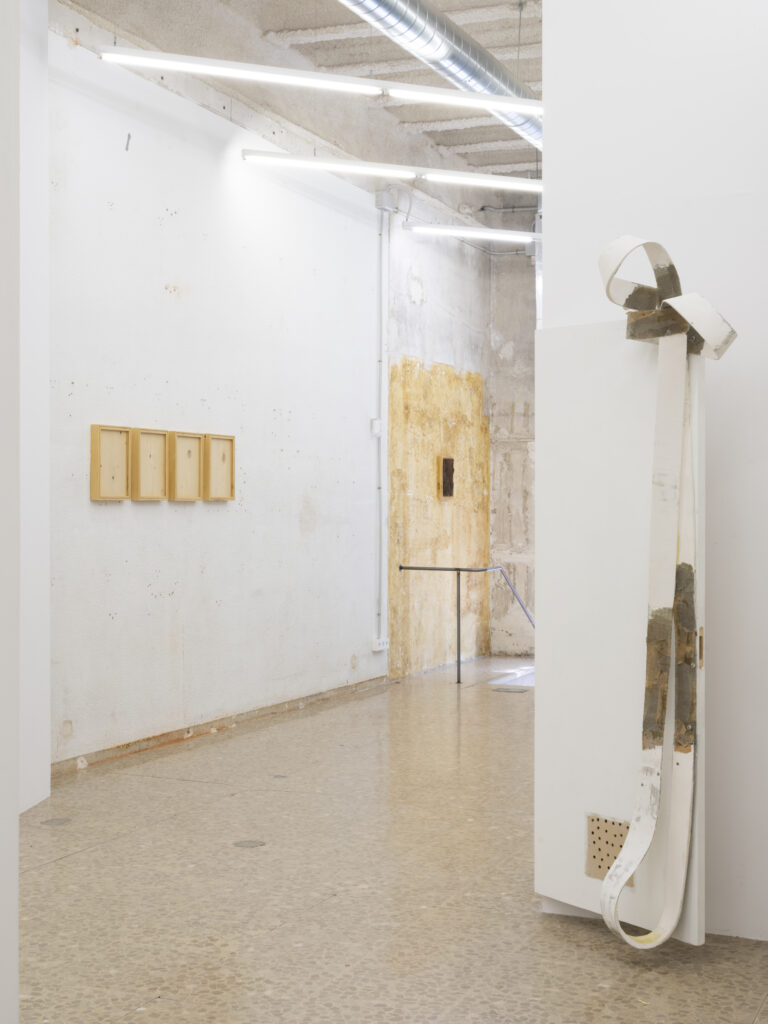
In Lucía Bayón’s works, this doubling is translated into the exhibition space as a material operation. What at first appears to be structure—wood, support, architecture—also becomes a passage towards an image that does not immediately reveal itself, but instead requires a shift in body and gaze. Through the twisting of planes into volume, her works activate a logic akin to nodal topology. The pieces place their own systems of articulation and support under tension, leaning on pre-existing elements such as doors or frames that carry a previous life, rewritten here through overlapping layers of information. The impossibility of a total view compels the viewer to repeat the work’s gesture, twisting space with their own body in order to access what remains partially hidden, and in so doing destabilising the coordinates between horizontal and vertical, surface and depth, seeing and being seen.
In Aleix Plademunt’s work, this doubling unfolds through a material and temporal cycle that folds back upon itself. Beginning with a dead century-old cypress from the cemetery of Anglès, felled and fragmented, the artist reclaims its wood and turns it into the support for the very images that document that process. Tree, felling, partition, and representation are thus inscribed within one and the same chain, where matter becomes both the object of record and the condition of possibility for presenting the image. The frames, made from the wood of that cypress, function as a material echo of what they contain, establishing a continuity between life, transformation, and gaze. As in the gesture of Patti Smith’s poem—that self scattering seeds that will give rise to new trees, whose wood will be used to build the table on which those verses will be written—Aleix’s work proposes a circular logic in which each image contains both its own origin and its own projection. In this way, it activates an expanded temporality in which what was and what is coexist on the same plane. Here, the image does more than fix an instant; it sustains a process.
Thus, amid twists, folds, and mate- rial resonances, this exhibition takes shape as a space in which every form and every image seems to summon its own double, insisting on a logic of return in which nothing is ever given only once, or on a single plane. “I Saw You Who Were Me” then ceases to be a line of verse and becomes a gesture, a way of making: that of the craftsman of love who, like the works themselves, produces bonds and assemblages in which matter and gaze are tied together. Within that movement, love appears as praxis: a way of working with the other, of holding and being held, of allowing oneself to be transformed by it.